
Is this the end for traditional hotels?
Airbnb is an online platform that offers accommodation to millions of people worldwide. Airbnb is very different from your typical hotel system. Firstly, people can offer their homes/flats and even singular rooms on Airbnb. Besides, the flexibility of the Airbnb platform allows consumers to add or remove rooms and properties at their own will. Airbnb is part of the sharing economy and is also classified as a peer to peer to the company. Also, there is no third party orchestrating the deal, whereas it is between the host and the guest while Airbnb provides the online platform for this to happen.
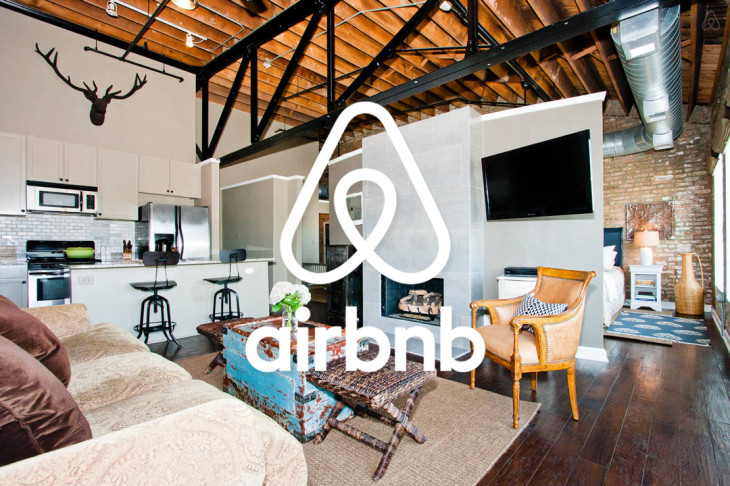
That shows you the flexibility which Airbnb provides consumers. Airbnb is regarded as one of the most successful start-ups of the millennium (Devanur, 2019). It has over 81,000 listed cities with over 2 million people using an Airbnb on any given night (Airbnb, 2020).
What separates Airbnb from its competitors?
Airbnb is now worth $35 billion (Ghaffary, 2019). Furthermore, Airbnb acts as prime competition in the already established hotel industry, with dominant chains such as Marriott who are the largest hotel group in the world. Marriott’s shares in the room and home rental industry have been impacted so much by the success of Airbnb that they decided on setting up their home rental, which is also app-based, according to (“Airbnb Faces New Competition as Marriott Offers Home Rentals”, 2019).
However, in the discussion of how successful Airbnb can be, some have argued that Airbnb is not in fact competition to hotels, but rather an alternative. “Airbnb’s potential impacts may be dismissed because Airbnb exists parallel with, instead of in competition with, traditional accommodation” (Guttentag, 2013, p.1205)
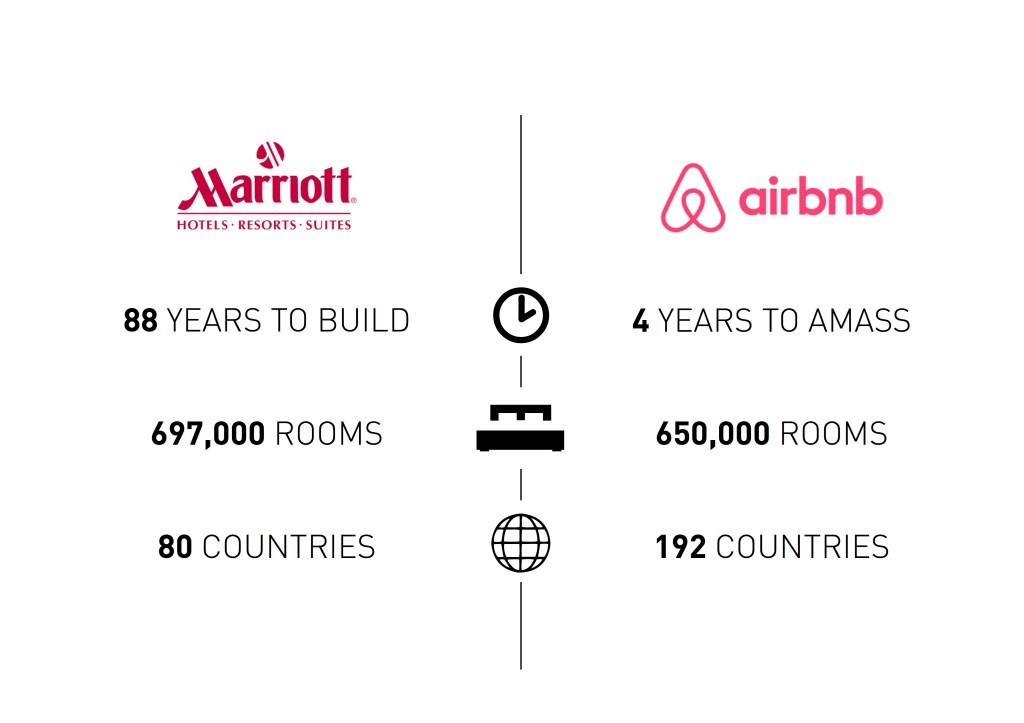
Moreover, Airbnb did not only disrupt the hotel industry, but it also disrupted the real estate industry. (Disruptive Innovation refers to a technology whose application significantly affects the way a market or industry functions (Twin, 2019). Airbnb does not own a single property; this is a big factor in which separates Airbnb from hotels.
Value proposition
- Easy to use app
- Ratings allow users to have a perception on where they are staying before they book
- Insurance for property which does not live up to their reputation.
Lets get Digital!
Algorithms and Appealing to the Masses
One of the biggest contributors to Airbnb’s success is the fact that it appeals to the many rather the few. Airbnb allows the host and the traveller to adapt their experience, by customisation which is done through data collection and algorithms which provide recommendations more accurate than they have ever been.
This allows people to have refined searches provided for them without having to go via third party companies such as booking.com or Trivago. In addition, these companies give different prices for potentially same hotel room. However, Airbnb is more transparent and straight forward. Also, Consumers get frustrated when they discover that they could have paid less via a different agent.
Referral system
Airbnb has been a massive success due to other digital aspects that have been previously mentioned. However, one of the potential game-changers for the company’s business model lies within the referral aspect.
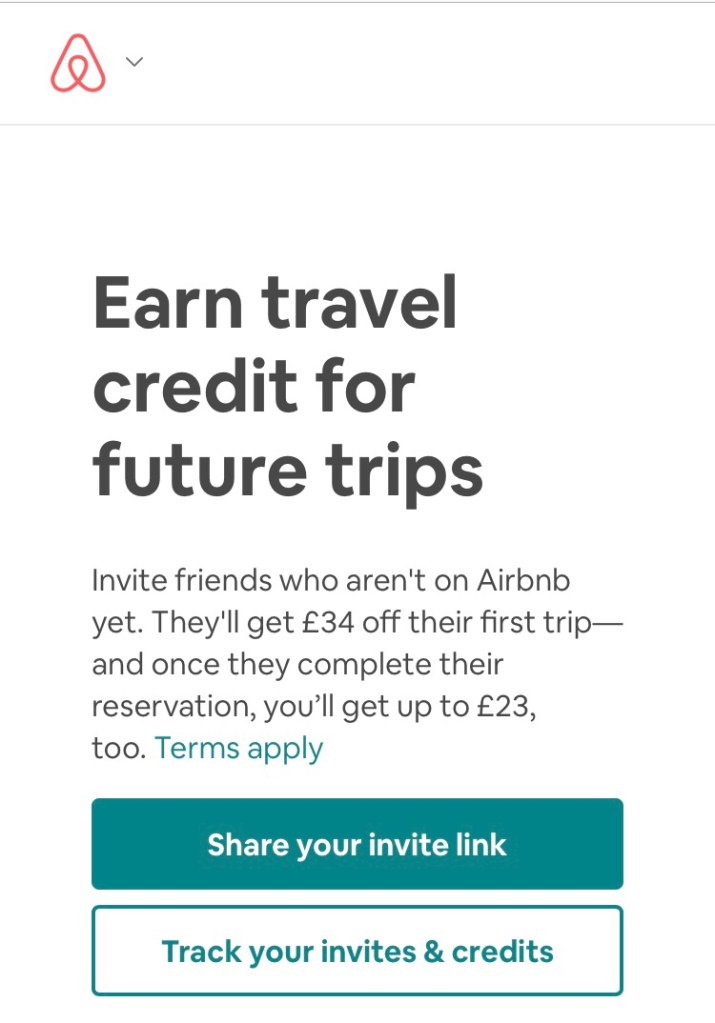
Airbnb allows users to get a personal recommendation code. This recommendation code allows users to share their experience and get their friends involved. Also, the user who shares the code gets incentives such as money off their next booking. The link takes them straight to the Airbnb sign up page.
Trust and transparency
The case of trust in their accommodation industry is always a mixed subject. Airbnb especially relies on trust more than traditional hotels. However, Airbnb makes sure that with every host and visitor, they must verify their identification through scanning their passport and uploading a picture. This allows the host to have a better idea of who they are dealing with. Also, the review system of the website is great because you can see real-life people’s responses and interactions with the host before booking.
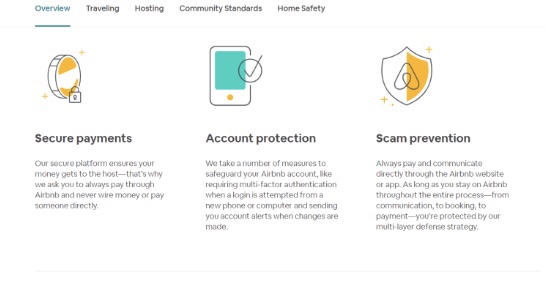
Airbnb encourages all communication and payments to happen via the app or the Airbnb website, whereas traditional hotels also offer phone booking which has resulted in a lot of phone scams. Therefore, the digitalisation of payment and communication has allowed Airbnb to gain success further through consumer retention.
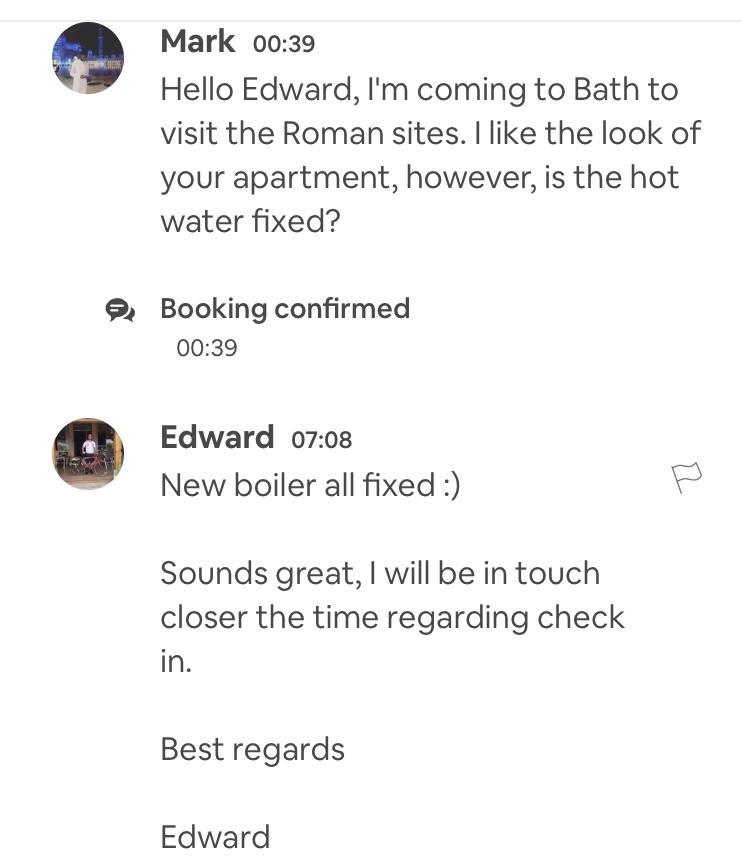
Furthermore, Airbnb has developed and patented software which will screen potential guests/ hosts. This can alert them if the host or the guest is a threat, therefore, they can look to take action (Holmes, 2020). Moreover, this will be a future method of consumer retention due to the trust which they place in Airbnb.

How will Airbnb stay successful?
As brilliant as Airbnb’s digital business model has been in this time of a new digital age. It has still faced obstacles and has many obstacles to come in the form of regulations and laws to protect the real estate industry. Moreover, the digital business model of Airbnb has proven to be one of the success stories of modern technology and entrepreneurship.
However, Airbnb can retain its status by continuously innovation which is the key to economic growth as Schumpeter discussed in 1974. In addition, competition will be fierce with time as technology continuously to become integral in society, traditional models will adapt and develop new methods to regain their market share from Airbnb.
Be formless,shapeless like water– Bruce Lee
References
Airbnb. (2020). Airbnb Trust & Safety – Your safety is our priority. [online] Available at: https://www.airbnb.co.uk/trust [Accessed 2 Mar. 2020].
Consent.yahoo.com. (2020). TechCrunch is now a part of Verizon Media. [online] Available at: https://consent.yahoo.com/collectConsent?sessionId=3_cc-session_a0aa423b-703d-4893-8171-77df60267bd5&lang=&inline=false [Accessed 5 Mar. 2020].
Devanur, G. (2019). Council Post: The Secret To Successful Startups. [online] Forbes. Available at: https://www.forbes.com/sites/forbestechcouncil/2019/04/05/the-secret-to-successful-startups/#dbb7f897e87c [Accessed 3 Mar. 2020].
Ghaffary, M. (2019). Marketplace Checklist: How Airbnb Built A $35 Billion Business On Its Brand Strength. [online] Forbes. Available at: https://www.forbes.com/sites/mikeghaffary/2019/05/30/marketplace-checklist-how-airbnb-built-a-35-billion-business-on-its-brand-strength/#248ab96c6147 [Accessed 4 Mar. 2020].
Guttentag, D. (2013). Airbnb: disruptive innovation and the rise of an informal tourism accommodation sector. Current Issues in Tourism, 18(12), pp.1192-1217.
Holmes, A. (2020). Airbnb has patented software that digs through social media to root out people who display ‘narcissism or psychopathy’. [online] Business Insider. Available at: https://www.businessinsider.com/airbnb-software-predicts-if-guests-are-psychopaths-patent-2020-1?r=US&IR=T [Accessed 6 Mar. 2020].
Moore, P. (2011). Social trust factors. [online] Available at: https://www.business2community.com/social-media/social-trust-factor-10-tips-to-establish-credibility-088362 [Accessed 4 Mar. 2020].
Sorman-Nilson, A. (2020). Futurist Keynote: Digital Disruption In The Hospitality Industry (1/2). [online] Anderssorman-nilsson.com. Available at: https://www.anderssorman-nilsson.com/blog/futurist-keynote-for-the-hospitality-industry-part-1/2 [Accessed 3 Mar. 2020].
Twin, A. (2019). Disruptive Innovation: Change That Upends a Whole Industry. [online] Investopedia. Available at: https://www.investopedia.com/terms/d/disruptive-innovation.asp [Accessed 3 Mar. 2020].
Zee, R. (2016). The ‘Airbnb effect’: is it real, and what is it doing to a city like Amsterdam?. [online] the Guardian. Available at: https://www.theguardian.com/cities/2016/oct/06/the-airbnb-effect-amsterdam-fairbnb-property-prices-communities [Accessed 4 Mar. 2020].
 Digital Business Models
Great post Mark! Really interesting look into Airbnb and its rise in the new digital age. Do you think that airbnb appeals to a particular age group as i feel the older generation would be sceptical of the app, as you spoke about with trust issues but the other way round rather the user of the house owner? Do you think the younger generation are more involved in the online world so are more trusting of it and do you think this will affect the future development of airbnb?
LikeLiked by 2 people
Thanks for your reply Hannah! I do agree that Airbnb does appeal to the younger generation more than the older generation. Until Airbnb begin to educate the older generation on the logistics of the company, the older generate will remain sceptical and use traditional forms of accommodation. I hope this has answered your question. In addition, I believe that Airbnb can provide more short video tutorials demonstrating how the process works.
LikeLike
Thanks for your reply Hannah! I do agree that Airbnb does appeal to the younger generation more than the older generation. Until Airbnb begin to educate the older generation on the logistics of the company, the older generate will remain sceptical and use traditional forms of accommodation. I hope this has answered your question. In addition, I believe that Airbnb can provide more short video tutorials.
LikeLike
A really interesting post Mark, and great insight into how Airbnb’s digital business model has contributed to its success. However, do you think that the flexibility of the platform and the fact that Airbnb don’t own any of the properties has contributed to the legal issues the company has been involved in since its conception? Barcelona is one such example where the local government has been involved in an ongoing legal case with the Airbnb over the advertisement and offering of unlicensed flats (Telegraph.co.uk 2018). And do you think these legal issues could ever lead to harsher consequences that would threaten the future success of the business?
The Telegraph (2018). retrieved from,
https://www.telegraph.co.uk/travel/news/where-is-airbnb-banned-illegal/
LikeLiked by 1 person
Hey Edmund! Thank you for your comment. I completely agree with your point about the legal baggage which has come with the rise in success of Airbnb. I do believe that Airbnb found legal loopholes to ensure that the company worked. However, I do believe that there are laws which may have permitted some of the Airbnb practices, such as advertising for individual rooms etc. In addition, I do believe that harsher sanctions will come for Airbnb and will therefore affect the future success of the company. Moreover, Uber is a company with a similar business model. They ended up losing legal battles and therefore are no longer in operation in London.
LikeLike
Hey, your view of Airbnb’s success is great! The digital business does help lots of companies to get benefits. Airbnb is one of the successful examples. From your article, I get to know that Airbnb is becoming the biggest competitor to Marriott. To be honest, the apparition of Airbnb changed the hospitality market and the way we travel. From the uncertainty of customers to the replacement of traditional accommodation, Airbnb offers the customer more customize options when they are picking stays. Customers can also earn money from sharing code to friends and invite them to use the app too. Although it is succeeding great now, do you think the customer’s privacy and accommodation quality control mechanism are the two biggest issues to Airbnb?
LikeLiked by 1 person
This article gives a good analysis of Airbnb’s business model. I think another reason why Airbnb stands out is that their business model frees up idle social resources, just as Uber frees people’s idle time to provide travel services for the society. However, management will become extremely difficult under this business model, because people who depend on the platform to make money are not regular employees. Didi, which is also part of the sharing economy, has seen violent incidents such as customers being harassed or killed by drivers in China. How do you think Airbnb will solve such management problems in the future?
LikeLiked by 1 person
Mark, your article has brilliantly categorised Airbnb’s business model into three main parts and clearly addressed the doubts about its future development. I totally agree with the point that other traditional models will gradually adopt the new digital models and regain their stakes within the market. Other than that, I believe that Airbnb is facing some legal challenges, where some countries do not recognise its rental transactions as legal and right. For instance, Japan has implemented a law requiring property owners to obtain a license and many listings had been wiped under its effects. Despite its successful digital model, do you think that these kinds of challenges will put its operation under jeopardy?
LikeLiked by 1 person
Hi Jacqueline, thank you for your comment. I do think that laws are coming into place to protect the traditional hotel industry and the real estate industry. I know of friends who have rented Airbnb’s for 6 months rather than using estate agents like the traditional way. However, the best companies find ways to solve problems and are adaptable. Thus, I believe that Airbnb will continue to find loopholes in the law to enable their continued success in the future.
LikeLike
I really love Airbnb and I am a loyal customer of Airbnb. I have been using the platform to prepare my travel Since I went to college. The unique experiences brought by each houses of Airbnb make me keep use and love it. The new concept of sharing economy created by Airbnb requires people to open their doors and rent their houses to strangers they have never met before. When we talk about ebbing today, it’s not difficult to understand its business model, but it is the only company that bears almost everyone’s doubts, gets through it and finally sticks to it, thus changing the world. In my opinion, good use of the Internet and digital techs, and courage to innovate make Airbnb successful. However, such sharing business model also generated some problems, especially private issues, which push Airbnb develop more useful approaches to solve.
LikeLiked by 1 person
Thank you Qianqian for your reply. I definitely agree with what you are saying. However, I do think that increased privacy measures such as AI screening will reduce scepticism when in comes to Airbnb.
LikeLike
The three biggest points that had my brain spinning were: “….Airbnb is regarded as one of the most successful start-ups of the millennium (Devanur, 2019).” “It has over 81,000 listed cities with over 2 million people using an Airbnb on any given night (Airbnb, 2020).”
“…some have argued that Airbnb is not in fact competition to hotels, but rather an alternative.”
I like that you mention how successful of a start-up Airbnb is/has been, because who doesn’t want to be part of something from the very beginning. And you mentioning that makes me feel like I am a part of the ‘cutting edge’. Second, you backing the mention of start-up to now established company by using the fact that 2 million people spend the night using Airbnb around the world on a given night is basically, fascinating. Finally, this has me thinking, are hotels taking a huge hit because of this? Are business people choosing to stay at an Airbnb instead of a chain and ‘trustworthy’ hotel? You address this very question by stating that conversations being had are not suggesting that hotels are completely being left with empty beds. They may see some numbers change, but that ultimately Airbnb is serving a completely different (and possibly new market) of consumers.
Overall, I really enjoyed this article.
LikeLiked by 1 person
Hi Erica, I appreciate your comment. It is very interesting how Airbnb has shocked the hotel industry this much! I do believe that a lot of Airbnb’s success is down to the younger generation. The younger generation would rather get an apartment with 4 bedrooms and live like the locals than 4 individual lifeless hotel rooms. This is the case in big tourist cities such as London, Barcelona and New York. Also, I feel like business people are still stuck in the loop of traditional hotel rooms, however, I believe in the foreseeable future, this will change. I think companies who pay for employee’s accommodation on work travel will look to cut costs by using Airbnb instead of hotels.
LikeLike
Hi, your post is really interesting. You mentioned in the article that airbnb does not own any property. Do you think this will cause it to have legal problems in some countries? How does the company deal with these lease transactions? In addition, some places have imposed regulatory restrictions on the vacation rental market to protect residents’ homes. Many cities with high accommodation costs, such as San Francisco, Toronto, and Vancouver, have recently begun to restrict short-term apartment rentals by commercial property operators to avoid aggravating local housing tensions. How do you think airbnb should respond to this protection of real estate?
LikeLiked by 1 person
Mark, what a great post! It’s interesting to see how platforms such as Airbnb can connect the end consumer with a seller. Whilst this is a great model, as has been mentioned in previous comments, do you think that the fact that Airbnb does not physically own any of the property will cause it to have legal issues in some countries? Just like we have seen with Uber, it can be difficult to regulate these business models. Difficulties can arise when regulating both the standard of the residents’ homes, the behaviour of the end consumer and also when considering restrictions to the vacation rental market. Is there anything Airbnb can do to safeguard against these issues?
LikeLike
Great article! I also think Airbnb is an amazing company to have reached such a huge level of growth. It’ll be interesting to see how they manage future threats like the Corona Virus.
LikeLike